Search Videos or Curiosity Videos? Finding the Mix Your Channel Responds To
For a while I believed the title was the whole game. Make it loud enough, promise something big enough, and the video would travel. Sometimes it did. The click-through rate would look healthy for a day, then the retention graph would fall off a cliff, the views would die inside a week, and the channel would sit exactly where it had been before.
What I had missed is that a title has two jobs, not one, and they are not the same job. It has to be findable, and it has to be worth clicking. Chase only the second and you are gambling. Chase only the first and you are publishing into a silence.
The interesting question is not which kind of keyword is better. It is how much of your publishing schedule should go to each.
The two kinds, briefly
Search keywords come from something a viewer is actively looking for. How to stop overthinking at night. Best free video editing software for beginners. They have measurable demand, they are slower to build, and they keep working long after the upload date because the question keeps getting asked.
Curiosity keywords come from a feeling rather than a question. The habit that is quietly ruining your sleep. Nobody talks about this part of the job. Nobody types these into a search box. They live or die on being shown to somebody, and when they land they can travel much further than a search video ever would.
Most creators end up leaning hard on one of the two without ever deciding to. That is the part worth fixing.
What happens when you only publish one kind
A channel built entirely on search phrases becomes safe and slightly invisible. Every video is correct. Every video answers something. The traffic is steady, the audience is well-matched, and nothing ever breaks out, because nothing was ever built to. You look at the analytics after six months and see a flat, respectable line.
A channel built entirely on curiosity phrases has the opposite problem. Some videos do genuinely well. Most do very little. Because the performance depends on packaging and timing rather than on a question somebody was already asking, you cannot tell whether a good week was a decision or a coincidence, and the numbers swing so hard that reading them becomes guesswork.
Three mixes, and what each one is for
There is no correct ratio, and anyone who gives you one without asking about your niche is guessing. What follows is how I think about the choice.
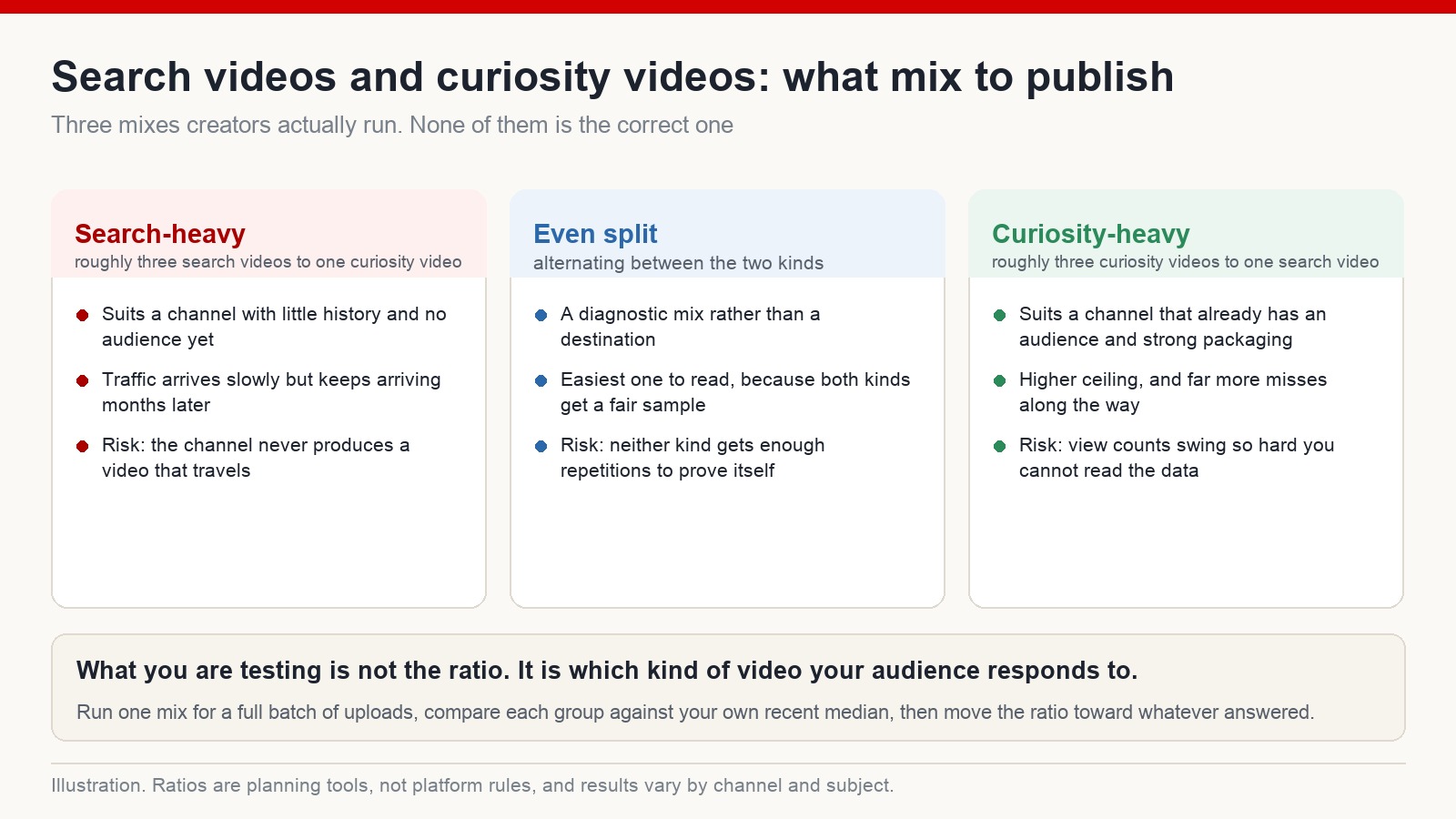
Search-heavy — roughly three search videos to one curiosity video. This is where I would start a channel with no history. The bulk of the schedule answers questions people are already asking, which gets some traffic arriving early and keeps arriving. The occasional curiosity video is there as a probe: it tells you whether this audience responds to that kind of packaging at all, and it costs you one upload to find out.
Even split. A diagnostic setting rather than a destination. If you genuinely do not know which way your niche leans, alternating gives both kinds a fair sample. The weakness is that neither kind gets enough repetitions to prove much within a short run.
Curiosity-heavy — roughly three curiosity videos to one search video. This one earns its place once a channel has an audience, a recognisable look and someone who is good at packaging. Without those three things it is mostly a way to publish a lot of videos that nobody sees. The single search video in the batch acts as a floor, so the channel still has something bringing in viewers when the swing-for-the-fences uploads miss.
Running it as an actual test
A ratio is only useful if you read the result afterwards, and most creators never do. The routine that works is unglamorous.
- Pick a mix and hold it for a full batch of uploads — enough videos that one anomaly does not decide the answer. A handful is not a sample.
- Tag each video, before publishing, as search-led or curiosity-led. Doing this afterwards guarantees you will remember it the way that flatters the result.
- When the batch is done, compare the two groups against each other, and both against the median of your own recent uploads. Not against a published benchmark from a channel with a different size, audience and subject.
- Look at more than the view count. A curiosity video with a strong opening minute and one that empties in twenty seconds are telling you completely different things, even at the same number of views.
- Move the ratio toward whatever answered, and run it again.
This is the part where most channels stall. People test, get a signal, and then keep publishing exactly as before because the signal did not match what they hoped for.
Dig into what is working
Say you run a search-heavy batch and one curiosity video pulls far more reach than anything else, and holds people once they arrive. The instinct is to note it as a nice surprise and carry on with the plan. The better move is to go straight back and make two more videos in that shape.
The reverse applies just as much. If the search videos are quietly bringing in viewers month after month while the curiosity attempts flop, that is not a failure of ambition. That is your audience telling you what it came for.
Platforms do not reward range for its own sake. They reward a channel that finds a pattern that works for its audience and repeats it. Deciding the ratio is how you find the pattern; repeating it is how you get anything out of it.
The better move: put both in one title
The ratio question assumes each video has to pick a side. Often it does not. Some of the strongest titles carry the searched phrase intact and wrap a reason to click around it.
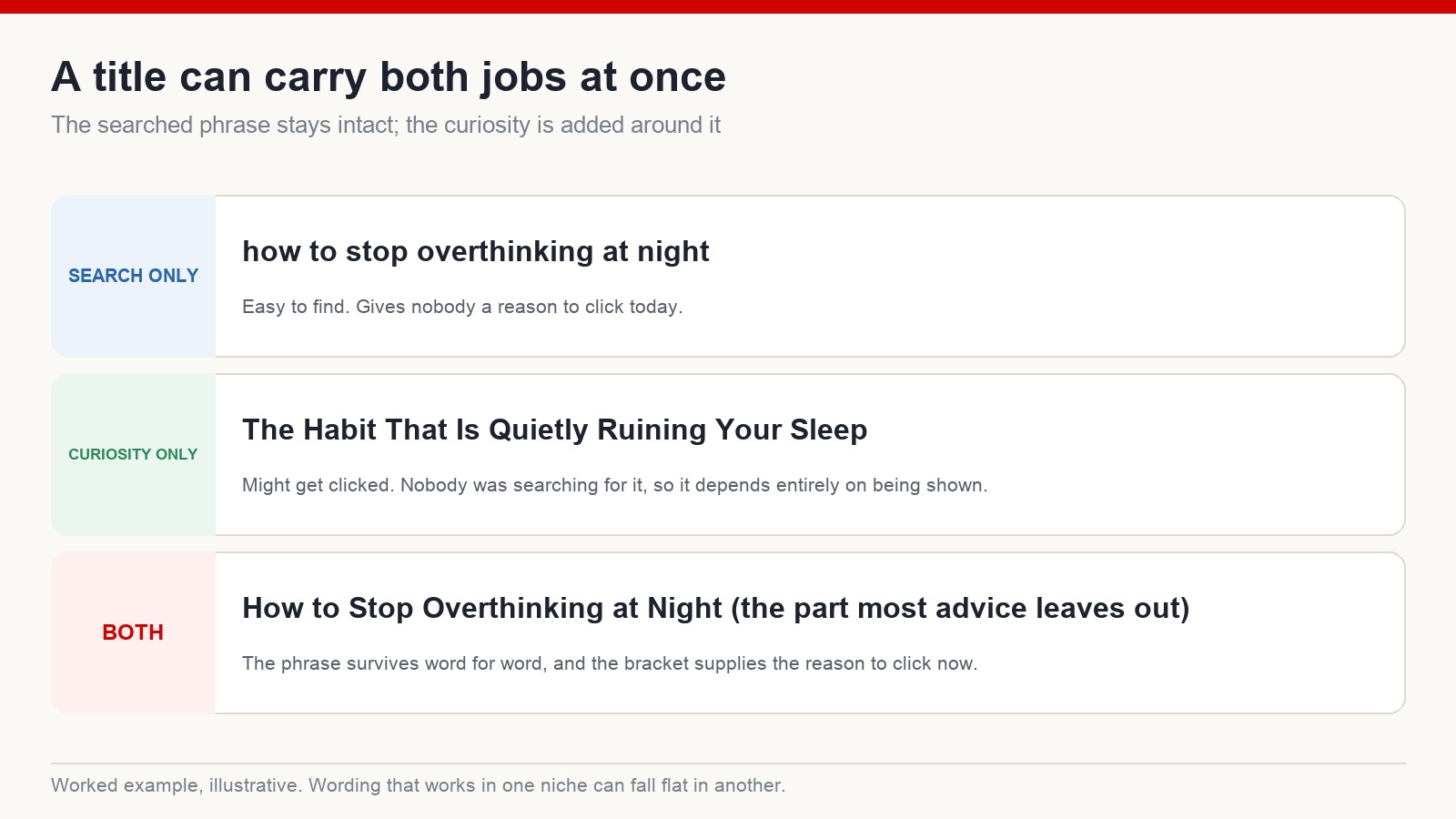
Take how to stop overthinking at night. As a title, it is completely findable and gives nobody a reason to watch today rather than next month. Now: How to Stop Overthinking at Night (the part most advice leaves out). The phrase survives word for word, so it can still be found, and the bracket supplies the thing the plain version was missing.
Two rules keep this from going wrong. Keep the search phrase in its natural word order — break it up and it stops matching how people type. And do not add a curiosity hook the video cannot pay off; a title that oversells is the fastest way to lose people in the first thirty seconds, which is worse for the video than never being clicked.
Why the mix has to be revisited
Distribution shifts. There are stretches where the home page and suggested feeds seem to be carrying more of the load, and stretches where search-led videos do the steady work. Audiences change too, and a subject that was under-served when you started can be crowded eighteen months later.
A creator locked into one ratio is making a bet on conditions that will not hold. The point of running the mix as an experiment is not to arrive at a permanent number. It is to keep a cheap, repeatable way of asking what is working right now.
Where I would start
If you have no data yet, a schedule that leans toward search phrases with a regular curiosity probe is a reasonable opening position. It gives the channel a floor while you learn something, and it is easy to move in either direction once results come in.
Two honest caveats. Nothing here guarantees views — a well-mixed schedule of badly made videos performs like any other schedule of badly made videos. And results differ enormously between subjects, languages and channel sizes, so treat any ratio, mine included, as a starting point to calibrate against your own numbers rather than a rule to follow.
Frequently asked questions
Which kind should a new channel prioritise?
Search phrases, in most cases. They have measurable demand, so you can tell before publishing whether anyone is looking for the video, and the traffic keeps arriving after the first week.
Are curiosity keywords worth using at all?
Yes. They are how a channel produces a video that reaches beyond its existing audience. The mistake is building the whole schedule out of them before you know your packaging works.
Is one particular ratio better than another?
No. The ratio is a way of running an experiment, not a setting to get right. What matters is holding one long enough to read the result.
Can a single title do both jobs?
Often, yes, and it is usually the strongest option: keep the searched phrase whole and add the reason to click around it.
How long before I judge a mix?
Long enough that one unusual video does not decide the answer, and long enough for search-led videos to accumulate the slow traffic that is their whole advantage. Judging a search video in its first forty-eight hours measures the wrong thing.
If you want to see how this fits into building a faceless channel for English-speaking audiences from the beginning, the system I teach is at mmoyoutube.com. Results vary by channel, subject and market.